Italy Proposes Digital Euro Fee Exemption for Small Transactions
What does a 2.01 percent slide in Nvidia have to do with the price of a coffee in Milan?
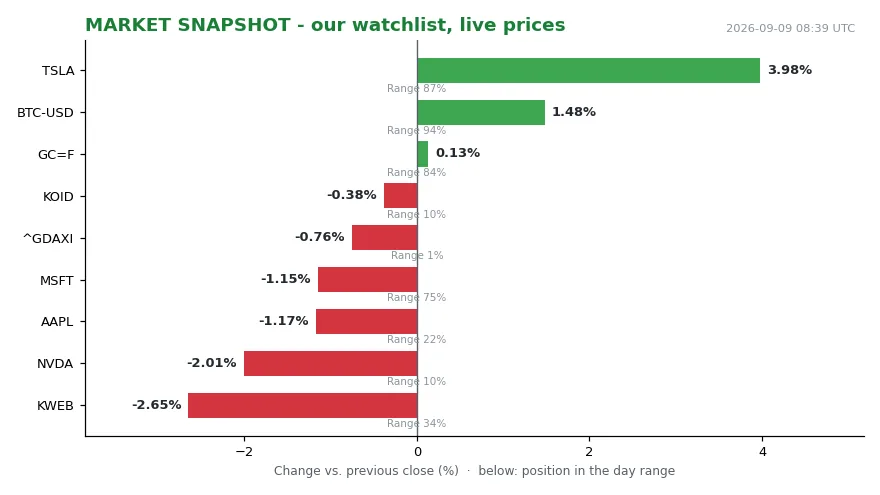
On the surface, nothing: our market data, fetched this morning at 07:50 UTC, shows Nvidia down 2.01 percent and trading near the day's lows, at just 10 percent of its daily range. Apple has slipped 1.17 percent and sits close to its lows. Tesla, up 3.98 percent and near the top of its range at 87 percent, tells the other side of the story. Add gold, up 0.31 percent and resting at 99 percent of its range, and bitcoin, up 0.98 percent near its highs, and the pattern sharpens: rotation, not panic. Money is leaving crowded megacap technology and drifting toward assets that behave like stores of value. The drift runs through a channel we track in our signal layer: central banking, the most active theme over the weekend, with two events. The Milan coffee question lives in that same channel, and the answer is taking shape in Brussels this week.
The digital euro is a digital form of payment expected to complement cash, not replace it. The European Central Bank aims to be ready for a potential first issuance in 2029, assuming the necessary regulation is adopted this year. Payment fees are a hidden input into almost every price on every shelf; whoever sets the fees sets the terms of access to the economy.
The digital euro is a digital form of payment expected to complement cash, not replace it. The European Central Bank aims to be ready for a potential first issuance in 2029, assuming the necessary regulation is adopted this year. [6] Payment fees are a hidden input into almost every price on every shelf; whoever sets the fees sets the terms of access to the economy.
At the centre of the negotiation sits a single word: fee. In ordinary economics, a fee is a price, compensation for a service and a signal of scarcity. In the digital euro file, the fee is a tool for engineering adoption. Because the digital euro will have legal tender status, merchants will generally be required to accept it, subject to certain exceptions. Legislators therefore cannot simply let merchants absorb the cost; they are negotiating how fees should be distributed among market participants, a design known as the "compensation model". Alongside it, the "holding limits", the maximum amount of digital euro a wallet may store, form the second most delicate part of the talks.
Italy's proposal inserts a simple threshold into this machinery: below €10, no merchant fee. According to a Euronews report, an Italian diplomat said: 'But we're open to consider a net zero, as de facto this would be the result anyway. Such a solution would also make the framework simpler.' Simpler, in practice, means no micro-billing on micro-transactions.
The most interesting feature is not the exemption but its temporary nature. In a 2025 report, the European Court of Auditors found that the European Commission lacked sufficient data on merchant service charges and costs to effectively monitor the impact of existing price interventions in the payments market. .
The clearest winners are small merchants. The central banking community also welcomes the proposal, not least because the temporary model feeds the ECB's need for real-world payment data. Who loses is harder to name from the documents; the whole compensation model exists precisely because someone must carry the cost of acceptance. .
Negotiators meet again in Brussels on Thursday, 10 September. Three open variables will shape the outcome: whether the exemption threshold survives at €10, whether the fee cap holds at €0.02 or collapses into net zero, and how the holding limits are calibrated. The holding limits determine how much digital euro can circulate and where central bank money is allowed to gather. .
The outcome of the Brussels negotiations will set a precedent for how the EU manages payment infrastructure costs. A temporary exemption could provide the data needed to calibrate a permanent fee structure, while a net-zero model would shift the burden entirely onto merchants. The decision will also influence how other central banks approach digital currency adoption. .
The temporary exemption for transactions under €10 functions as a data-gathering mechanism for a market distortion that Brussels has long suspected but never fully measured. Whether the digital euro closes that gap remains an open question; the data needed to answer it does not yet exist. The fee negotiations are therefore not merely about pricing — they determine who bears the cost of Europe's payment infrastructure.